
 By SEO Support
There is a short list of pharmaceutical intermediates where sourcing decisions have a direct and traceable impact on the final drug’s quality. 7-Chloroquinaldine is on that list.
As the key starting material in the synthesis of Montelukast Sodium the widely prescribed leukotriene receptor antagonist used in asthma and allergic rhinitis management the quality of 7-Chloroquinaldine is not an upstream abstraction. It is a variable that flows downstream through every step of the synthesis process, appearing directly in the final API yield.
This guide is written specifically for procurement managers evaluating 7-Chloroquinaldine suppliers for commercial-scale or clinical-stage requirements. It covers what the compound is, what purity standards actually mean in practice, how to verify CAS identity, and the criteria that genuinely separate reliable suppliers from those who simply appear in a database search.
What Is 7-Chloroquinaldine and Why Is It Commercially Significant?
7-Chloroquinaldine is a highly reactive heterocyclic building block, commercially significant primarily as the key starting material in the multi-step synthesis of the antiasthmatic Montelukast Sodium Salt.
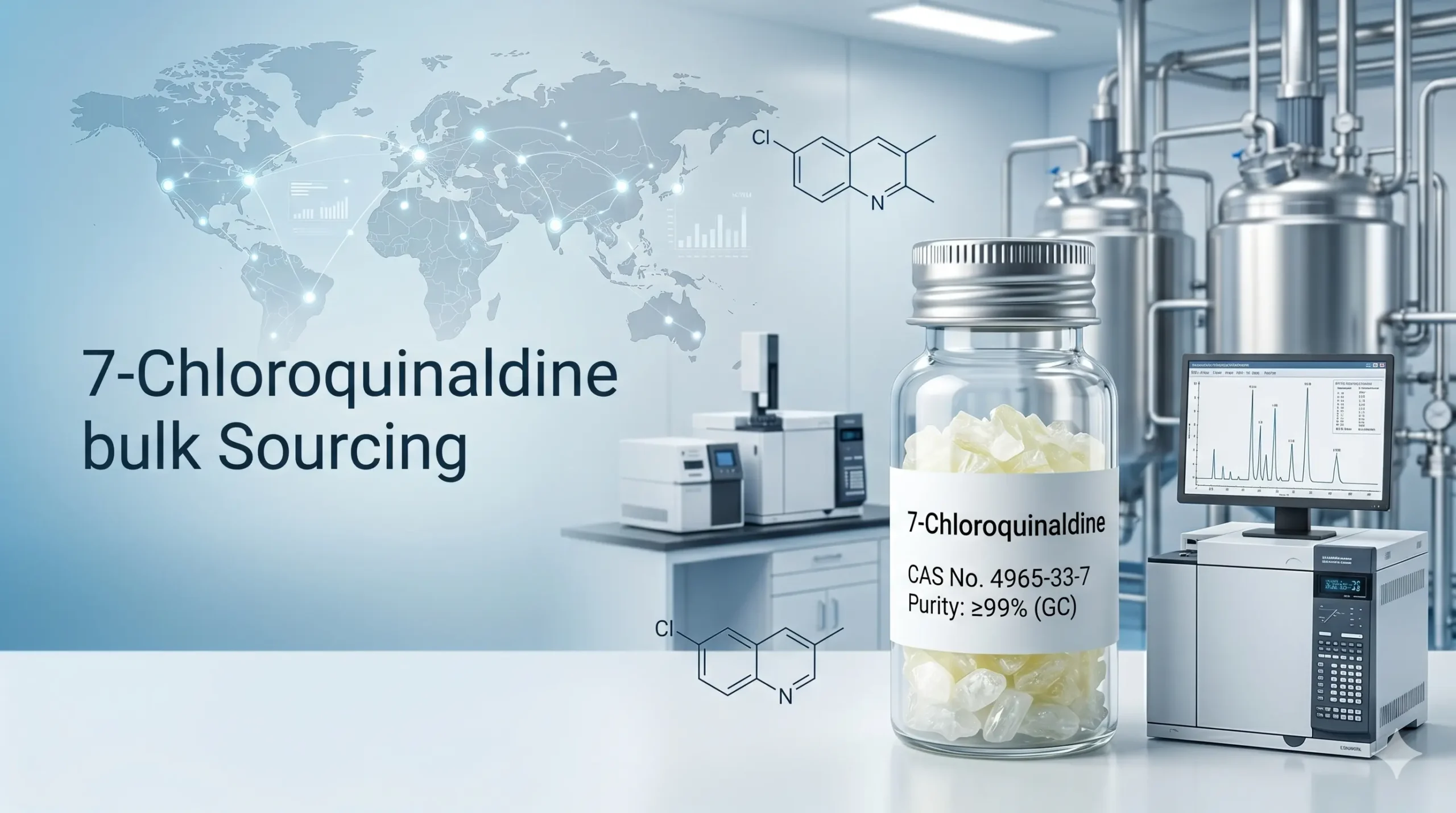
Also known as 7-Chloro-2-methylquinoline, the compound carries the CAS registry number 4965-33-7. Its molecular formula is C₁₀H₈ClN with a molecular weight of 177.63 g/mol. In its standard form, it presents as a white to pale yellow crystalline solid with a melting point in the range of 74–78°C.
Beyond Montelukast, 7-Chloroquinaldine serves as a key intermediate in developing antimalarial and antibacterial agents, and is explored in agrochemical development. Its utility across therapeutic and industrial applications means demand is distributed across multiple development pipelines simultaneously.
Why Is 99% Purity the Baseline for Pharmaceutical-Grade 7-Chloroquinaldine?
A 99% purity specification is the required baseline because the standard synthesis process generates a structural isomer byproduct 5-Chloroquinaldine that can ruin downstream yields if not strictly controlled.
The synthesis of 7-Chloroquinaldine involves a Skraup or Doebner-Miller reaction using m-chloroaniline and crotonaldehyde. During this reaction, 5-Chloroquinaldine is generated as a byproduct. This is the critical insight procurement teams often miss: 5-Chloroquinaldine is not easily visible on basic purity assays if the analytical method is not configured to detect it specifically.
A supplier reporting 98% purity via a general assay may carry a meaningful isomer load. This impurity will propagate through the Montelukast synthesis and create downstream quality failures that are expensive and time-consuming to diagnose. Pharmaceutical-grade 7-Chloroquinaldine requires 99% purity minimum, verified by Gas Chromatography (GC), with specific isomer profiling to confirm 5-Chloroquinaldine content is within controlled limits.
What Does CAS Verification Actually Confirm?
CAS number 4965-33-7 confirms the compound’s structural identity, but it does not confirm purity, isomer profile, residual solvent levels, or batch consistency.
CAS verification is only the first line of quality assurance. When evaluating a new supplier, the minimum documentation package must include:
- Certificate of Analysis (COA): Must be batch-specific. It should include assay percentage, analytical method (GC, HPLC, or both), melting point, appearance, and moisture content. Request COAs across three or more recent batches to assess consistency.
- NMR and IR Spectroscopy Data: Confirms structural identity beyond the CAS number. Any reputable manufacturer should have reference spectra readily available.
- Isomer Profile Report: Specifically documents 5-Chloroquinaldine content. Many suppliers cannot or will not provide this; those who can are operating with appropriate analytical rigor.
- Residual Solvent Analysis: Solvent carryover from production can affect downstream reactions and regulatory filings.
How Do You Evaluate a Reliable 7-Chloroquinaldine Supplier?
You evaluate a reliable supplier by verifying their isomer control capability, batch consistency, and regulatory documentation readiness, rather than relying solely on sample testing.
Here is how to evaluate the supplier base meaningfully:
- Isomer control capability: This requires process investment, not just analytical testing. A manufacturer who has solved the 5-Chloroquinaldine separation challenge at scale is fundamentally different from one screening out impurities at the QC stage.
- Batch-to-batch consistency: Acceptable variation in pharmaceutical intermediate supply is narrow. Wide variation in melting point data or GC assays signals process instability.
- Scale-up flexibility: Confirm the supplier’s installed capacity, current production utilization, and track record with customers at your required volume tier.
- Regulatory documentation readiness: If your end product will undergo regulatory review (USFDA, EMA), your intermediate supplier must be experienced in supporting Drug Master File (DMF) filings.
- Geographic risk profile: For buyers currently sourcing from China, the combination of geopolitical uncertainty and tariff exposure makes a qualified Indian alternative strategically necessary.
How Should You Structure the Supplier Qualification Process?
The qualification process should be structured across four stages: rigorous document review, independent analytical testing, technical auditing, and a pilot commercial order.
The time investment in getting this right before commercial orders begin is a fraction of the cost of a quality failure after it.
Advance Pharmachem manufactures 7-Chloroquinaldine (CAS 4965-33-7) at 99% purity with full isomer documentation from our Ambernath MIDC facility. We support bulk buyers through the entire qualification process with complete analytical transparency. Contact us to discuss your specifications and commercial-stage volume requirements.
Frequently Asked Questions
Q1. What is the CAS number for 7-Chloroquinaldine and what does it confirm?
A: The CAS number is 4965-33-7. It confirms structural identity specifically that you are receiving 7-Chloro-2-methylquinoline with the molecular formula C₁₀H₈ClN. It does not confirm purity, isomer profile, or batch consistency; those require a batch-specific COA and an isomer profile report.
Q2. Why is 7-Chloroquinaldine critical to Montelukast synthesis?
A: It is the key starting material in the multi-step synthesis of Montelukast Sodium. Its quinoline ring structure is essential to the downstream reaction chemistry. Any impurity particularly the isomer 5-Chloroquinaldine entering the synthesis at this stage can compromise final API quality and yield.
Q3. What purity level should bulk buyers require for pharmaceutical-grade 7-Chloroquinaldine?
A: The minimum acceptable purity is 99%, verified by Gas Chromatography. Buyers must also request a specific isomer profile report confirming 5-Chloroquinaldine content, which is the primary byproduct of the synthesis process.
Q4. Are there reliable manufacturers of 7-Chloroquinaldine in India?
A: Yes, though the supplier base manufacturing at 99% purity with documented isomer control is narrow. Advance Pharma Chem is among the few Indian manufacturers producing 7-Chloroquinaldine at this specification with full analytical documentation support for bulk buyers.
Q5. How should I structure the qualification process for a new 7-Chloroquinaldine supplier?
A: Follow four stages: first, document review (COAs, NMR/IR spectra, isomer data); second, sample procurement and independent testing; third, a technical questionnaire or audit covering KSM sourcing and QMS; and fourth, a pilot commercial order.
Leave A Comment
You must be <a href="https://advancepharmachem.in/wp-login.php?redirect_to=https%3A%2F%2Fadvancepharmachem.in%2Fblogs%2F7-chloroquinaldine-sourcing-guide-for-bulk-buyers-purity-standards-cas-verification-more%2F">logged in</a> to post a comment.